During my internship at Kraft Heinz, I worked on connecting packaging design, consumer insights, and project learnings in one consistent and shared structure to support better Pack CX decisions.
Through research and collaboration with cross-functional stakeholders, I developed a structured Consumer Experience Playbook to support decision-making during packaging development.
Some details have been simplified due to confidentiality.
START MY JOURNEY IN THE NETHERLANDS
Project / Team / Role
Pack Consumer Experience Playbook / Consumer Experience / UX Design Intern
Timeline
Sep 2025 – Feb 2026 (6 months)
At a high level, the project evolved through three stages:
Understanding the landscape — mapping existing practices, tools, and stakeholder needs around packaging CX.
Structuring knowledge — synthesizing research learnings and identifying opportunities for a shared framework.
Designing the Playbook — developing a Pack Consumer Experience Playbook to support cross-functional alignment.
Tools


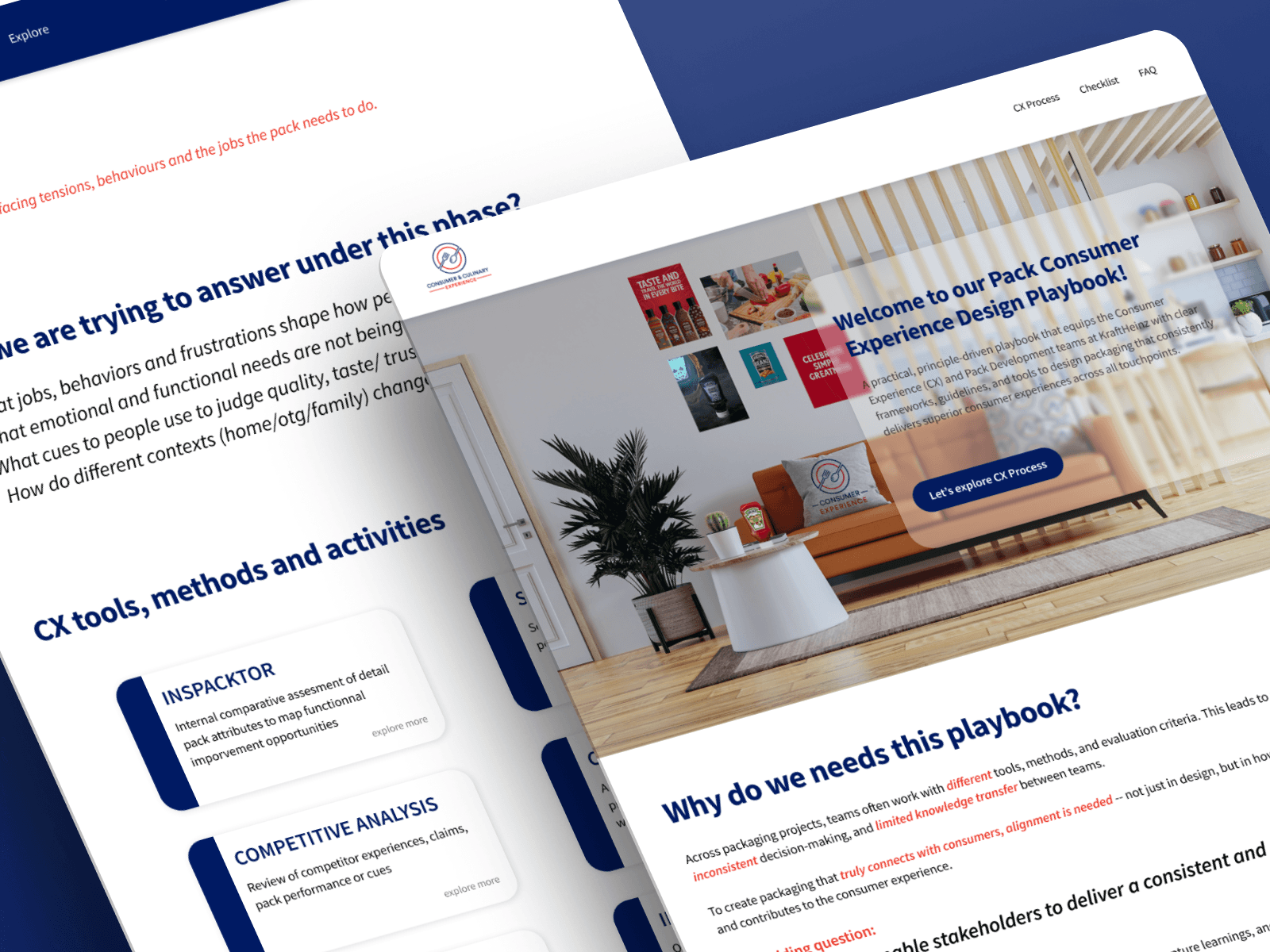
CX Pack Playbook — Research & Design Journey
Kraft Heinz CX Design Internship Project
Service Design
UX Design
CX Strategy
the Gap
Problem
Packaging innovation requires collaboration between cross-functional teams such as design, marketing, research, and development.
However, consumer experience insights are often fragmented across different projects and systems. As a result, teams may struggle to translate research findings and project learnings into actionable guidance during packaging development.
Key challenges
Fragmented insights
Consumer insights and project learnings are distributed across different sources.
Lack of shared structure
Teams do not have a common framework for evaluating Pack CX and lack of shared understanding.
Difficult decision-making
It is not always clear when and how current knowledge should inform packaging decisions.
Understanding the Landscape
Research Goal
To understand how consumer experience insights are currently used in packaging innovation projects and identify opportunities for framing structure.
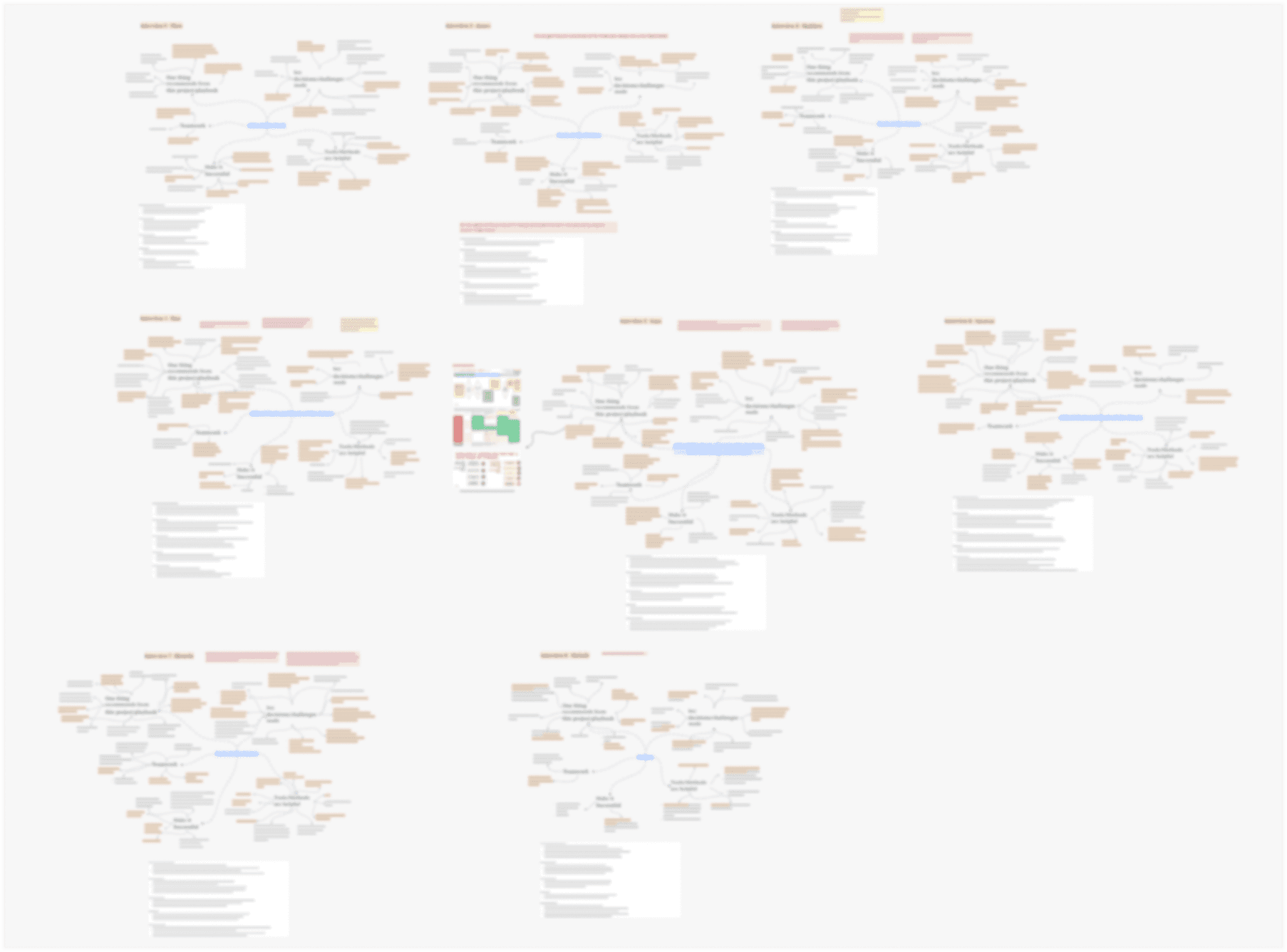
01 Benchmark & External References
Reviewed previous packaging projects to understand how consumer experience knowledge is structured and what challenges are facing.
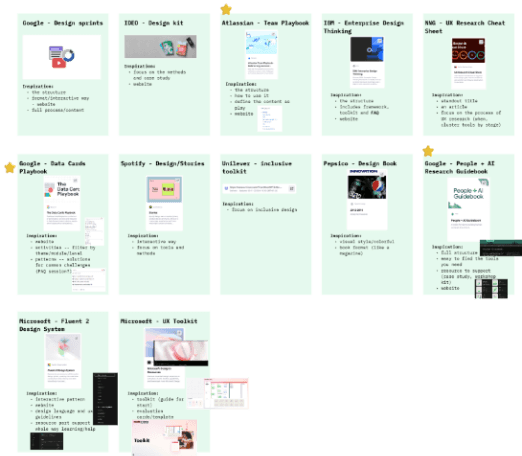
And understand how other companies organize and communicate their design/innovation knowledge.
02 Internal Stakeholder Interviews
Conducted interviews with cross-functional stakeholders to capture real experiences, challenges, and perspectives.
And validate and refine the insights from the benchmark comparison.
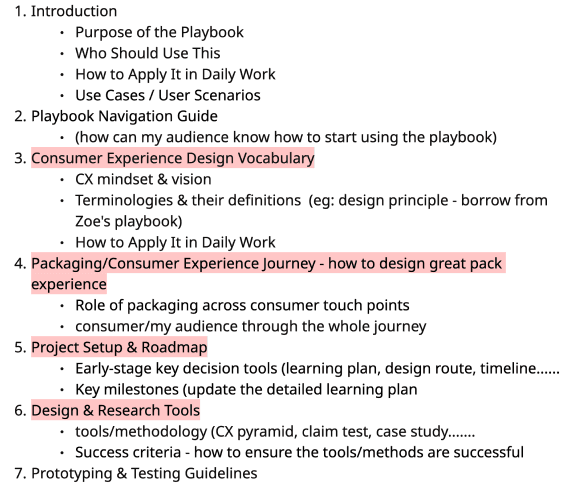
03 Framework Definition
Defined the initial structure of the Pack CX Playbook, organizing key sections that connect consumer experience insights with packaging development activities.
Research Question
How to enable the stakeholders to deliver good packaging consumer experience?
What we learn
KNOWLEDGE IS HARD TO NAVIGATE
Across projects, consumer experience insights appear in different formats. However, there is no clear entry point that helps teams understand where to start.
NO SHARED CX LANGUAGE
Interviews revealed that different teams often approach consumer experience from different perspectives. Without shared language, collaboration becomes inconsistent.
INSIGHTS NEED PROCESS CONNECTION
Rather than lacking insights, teams often struggle with how to translate insights into concrete actions within project developing stages.
Designing the Pack CX Playbook
Iteration 1 — Expanding and Structuring the Playbook
The first iteration focused on expanding the Playbook content and organizing it into a clearer structure.
Core chapters were developed, including the Consumer Experience Journey, Project Setup & Roadmap, and Design & Research Tools.
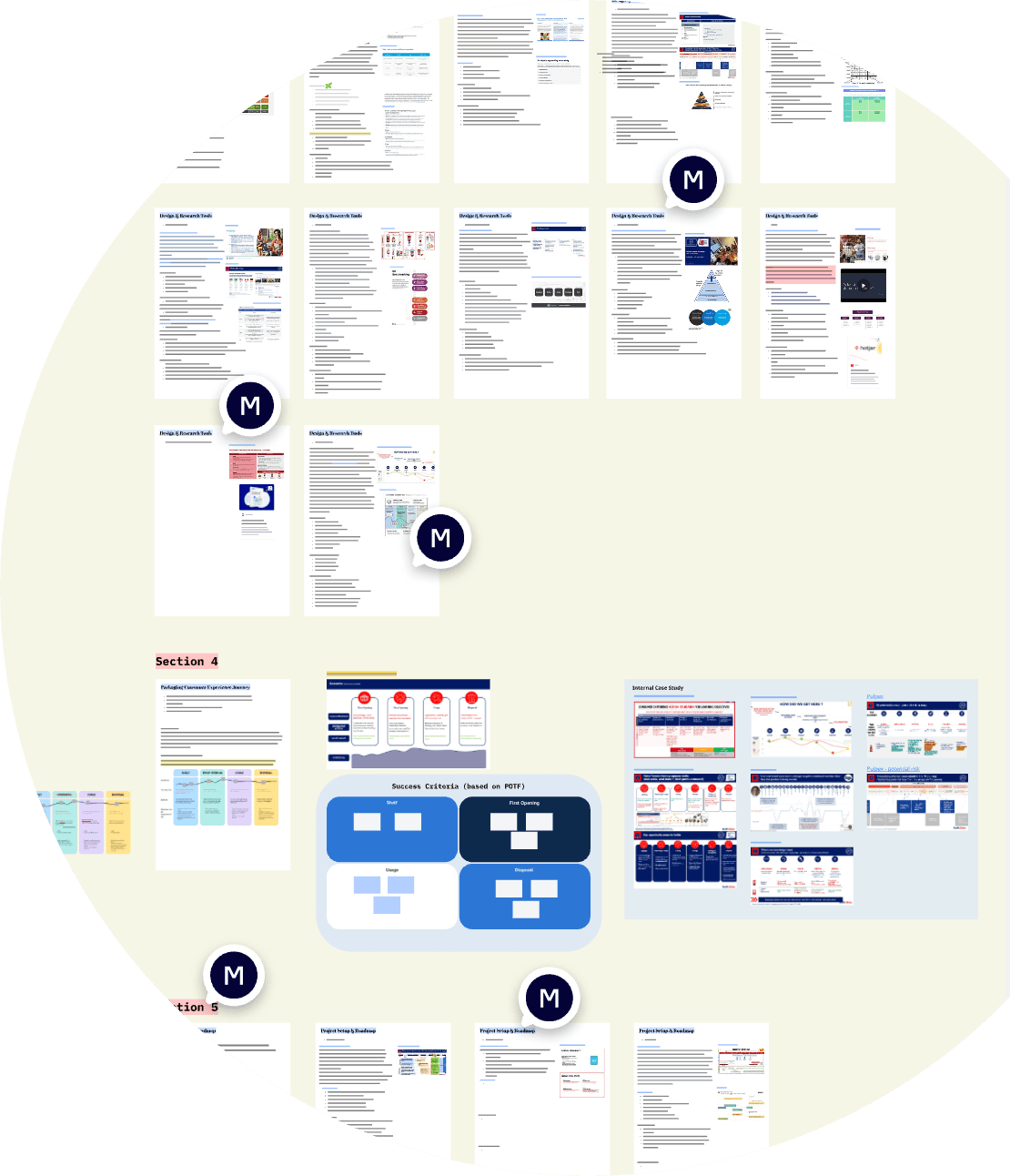
Through brainstorming sessions with CX stakeholders, we identified which tools were most relevant, what content needed refinement, and how activities could be organized into design phases.
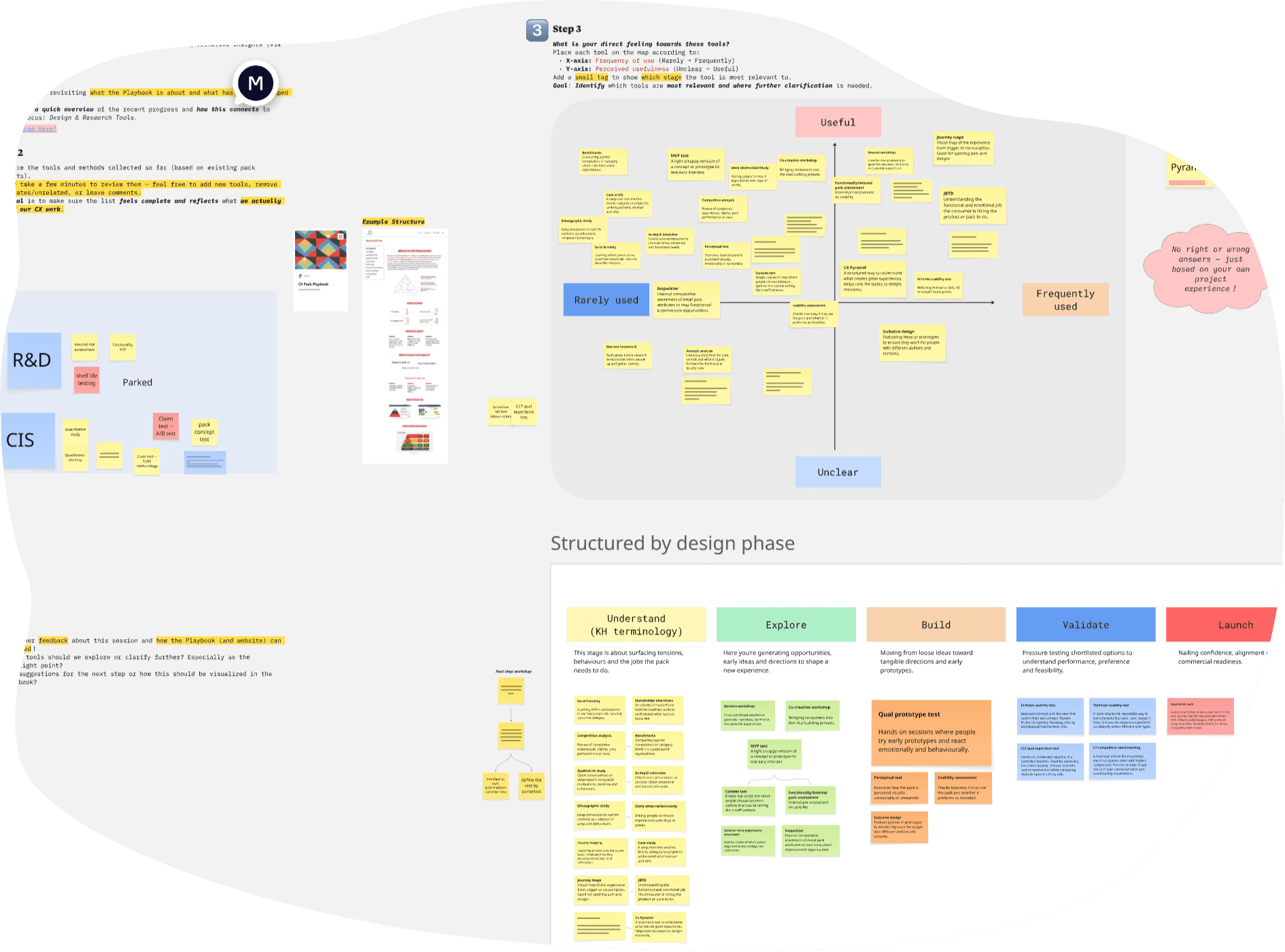
KEY OUTCOME
Expanded key Playbook chapters
Introduced a phase-based structure
Developed an early digital prototype to explore structure and navigation
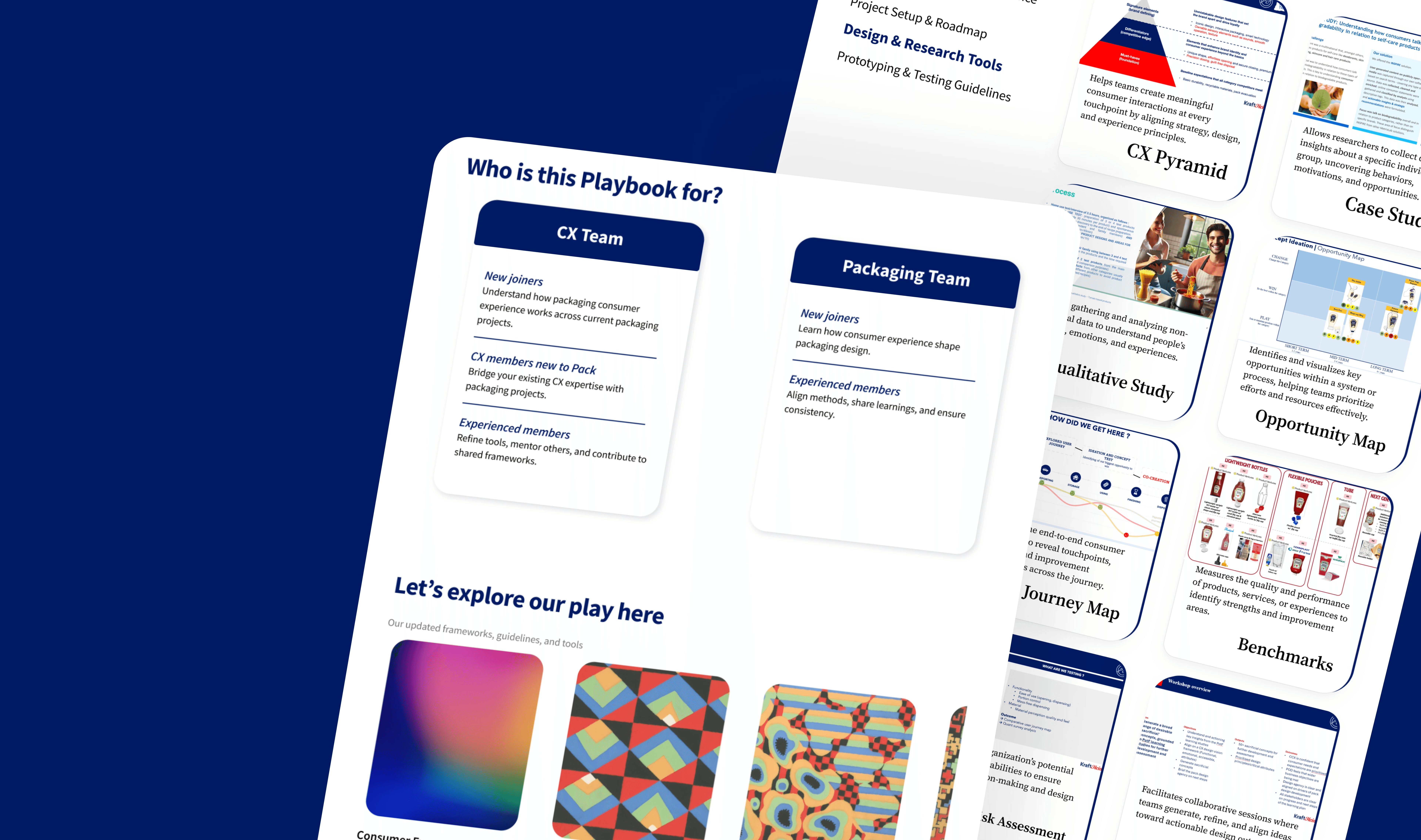
Developed an early digital prototype to explore structure and content organization.
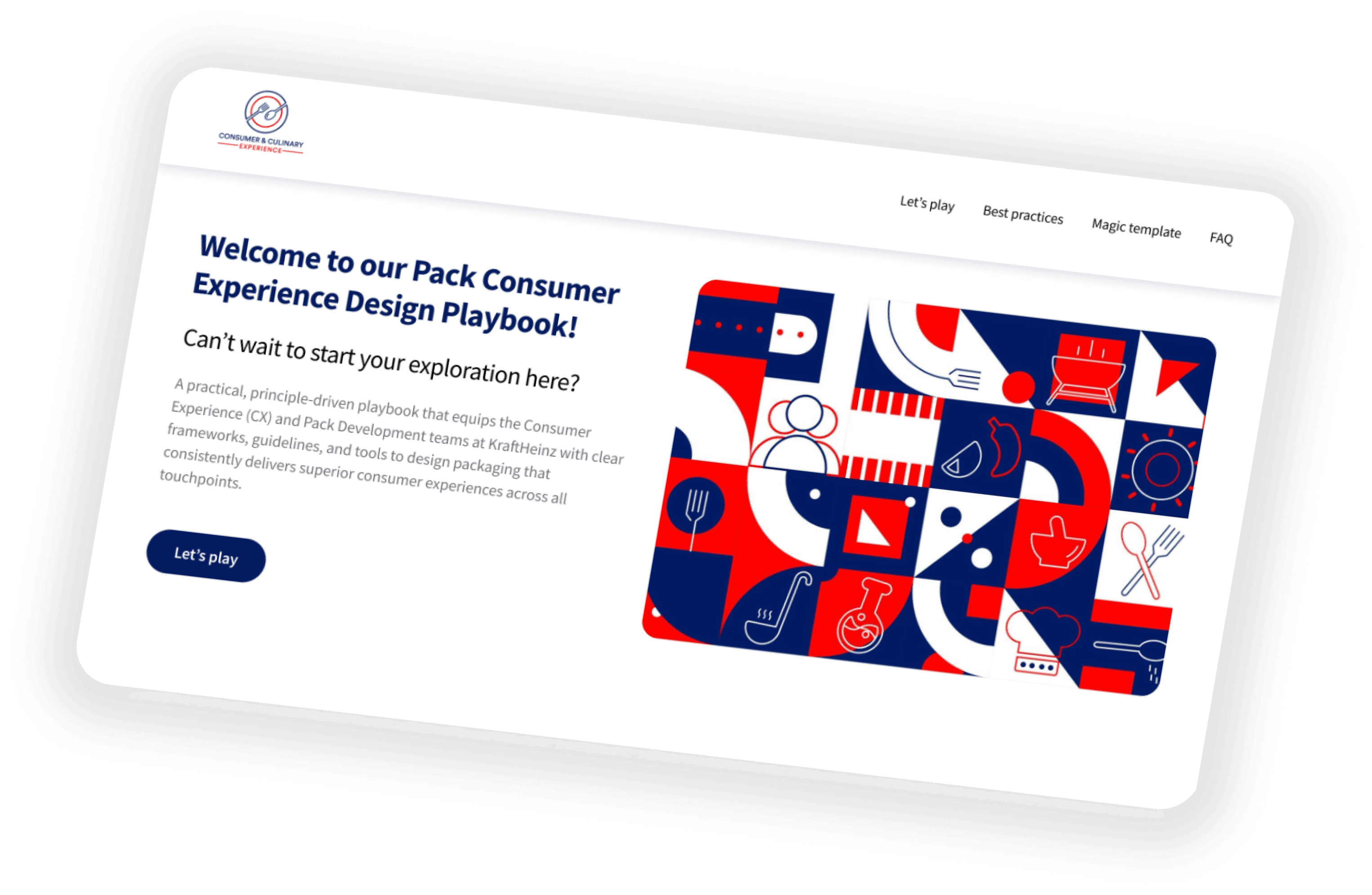
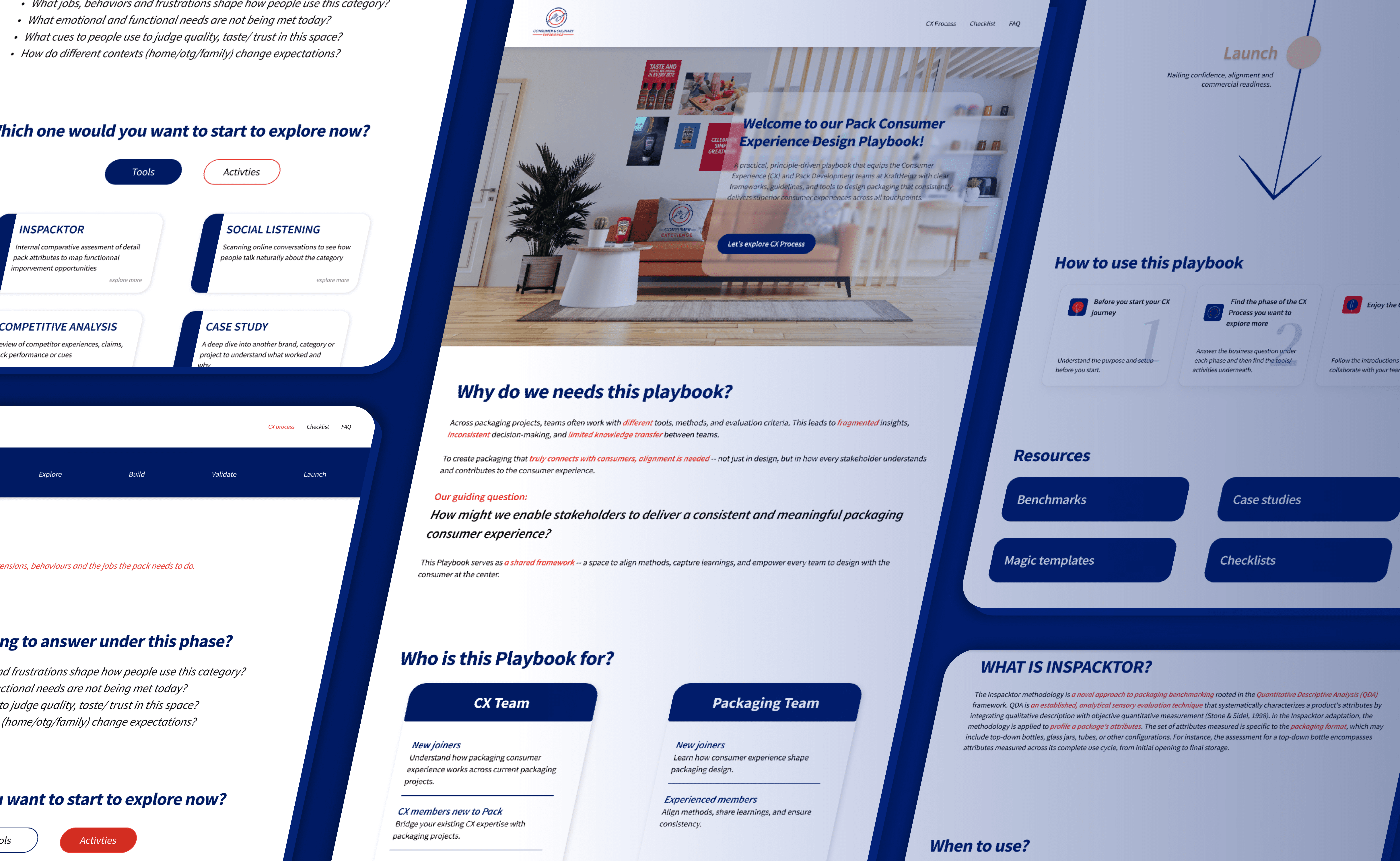
An updated prototype reflects improved structure and navigation.
Iteration 2 — Refining And Validating The Playbook
The second iteration focused on refining the phase logic and improving usability.
KEY OUTCOME
Refined the five-phase structure with business quesitions
Clarified and validated CX tools and methods
Refined the Playbook structure and improved logic for practical use
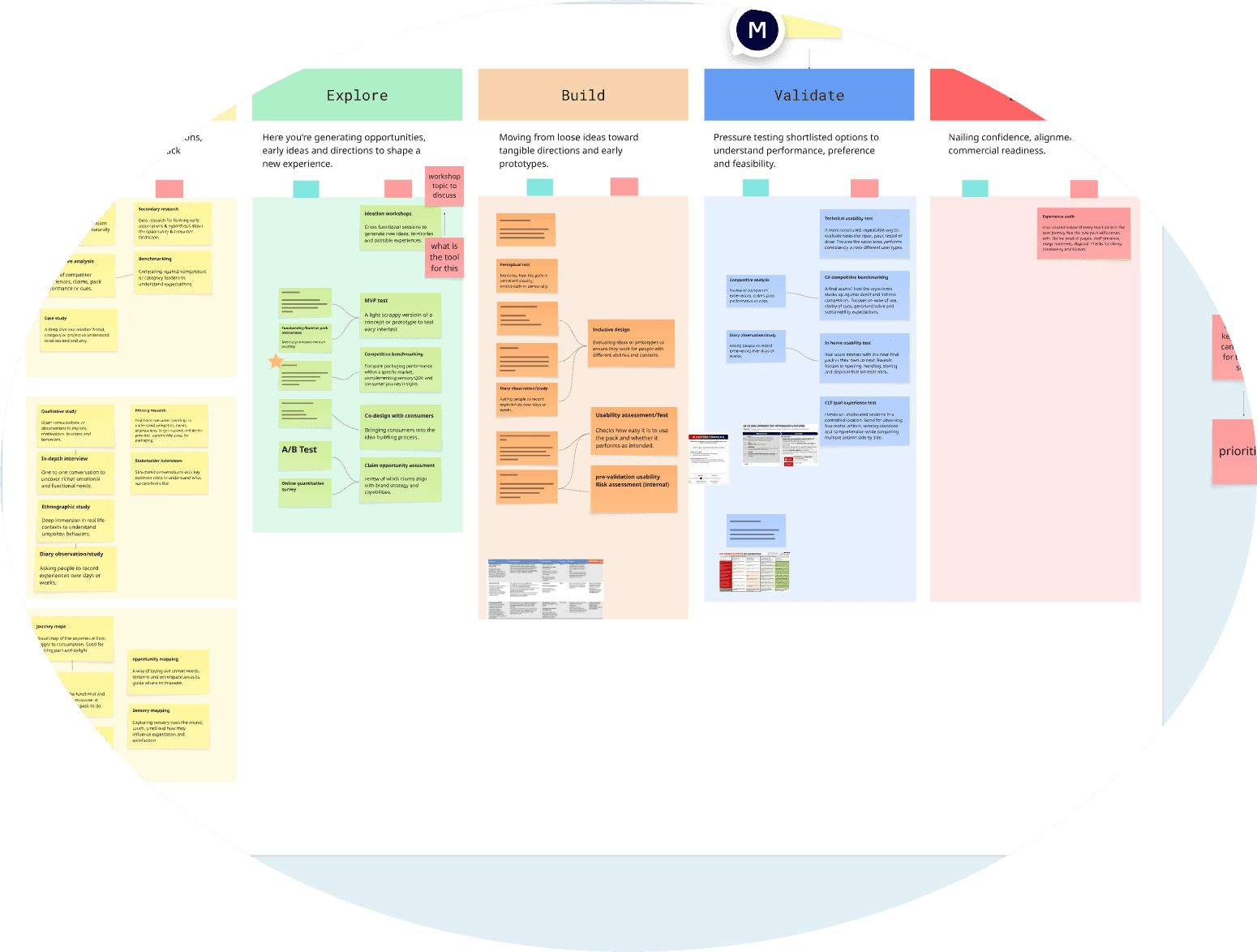
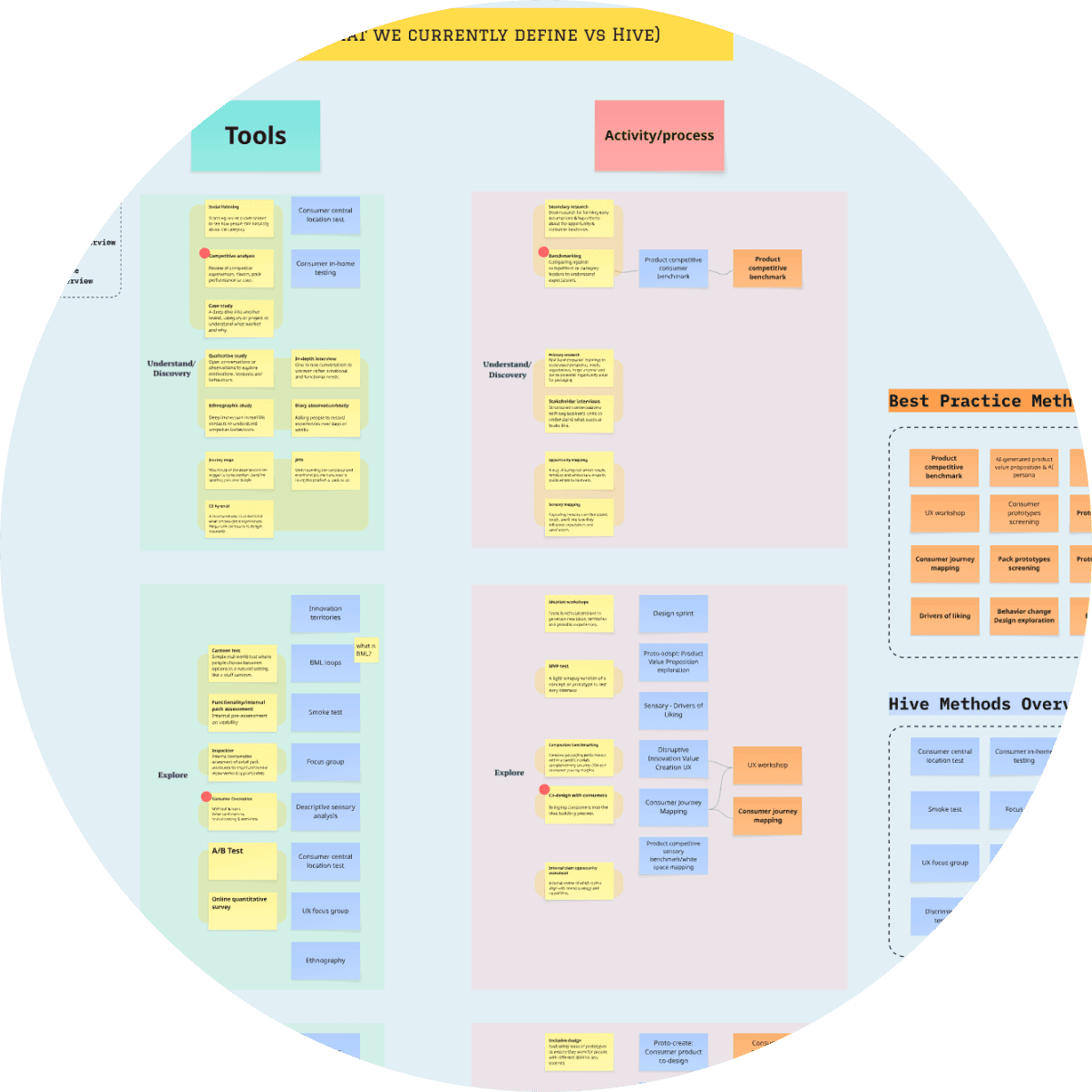
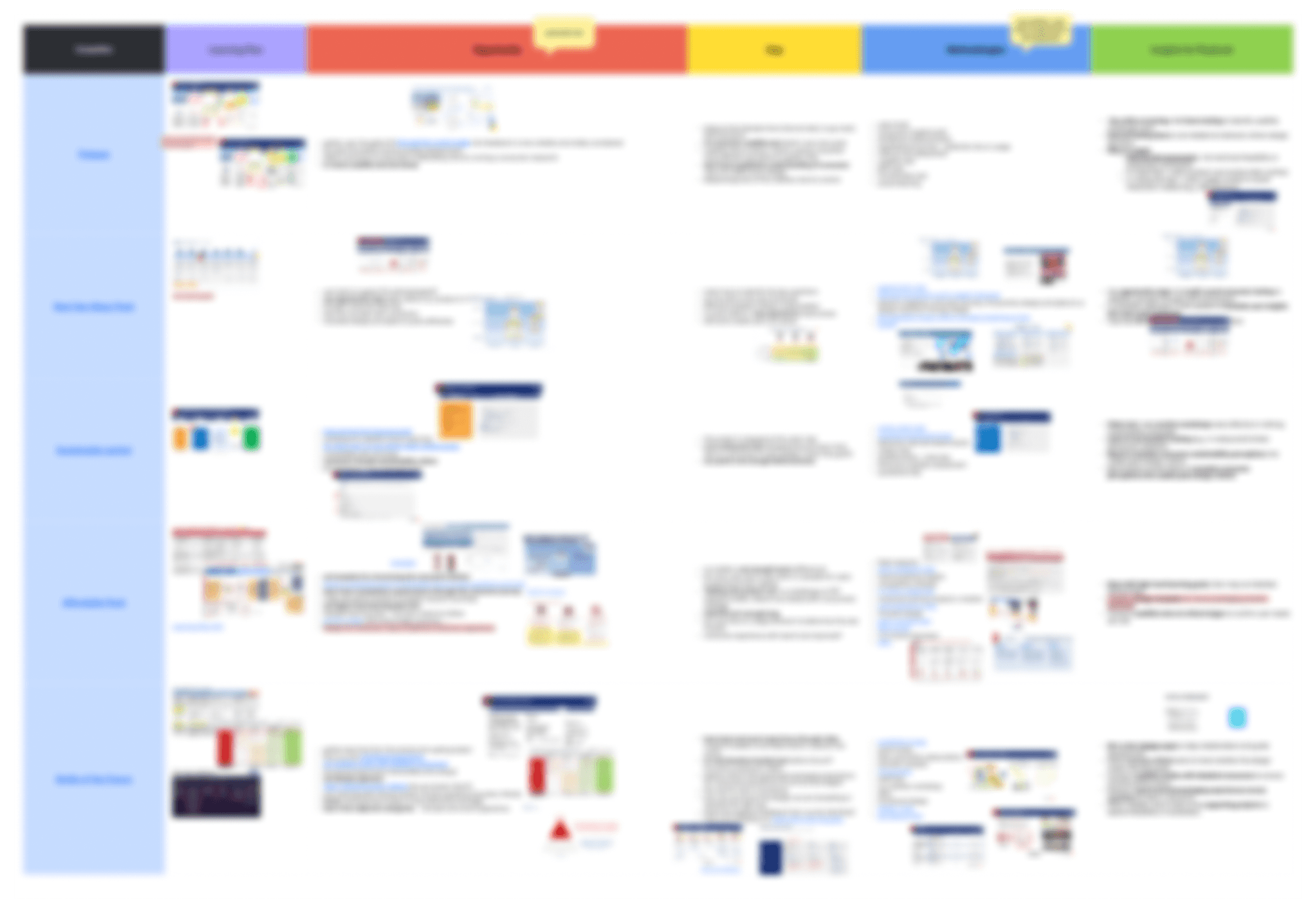
We refined CX tools and methods, clarifying whether each one is a tool, activity, or process, and mapped them into the five design phases and compared with HIVE framework.
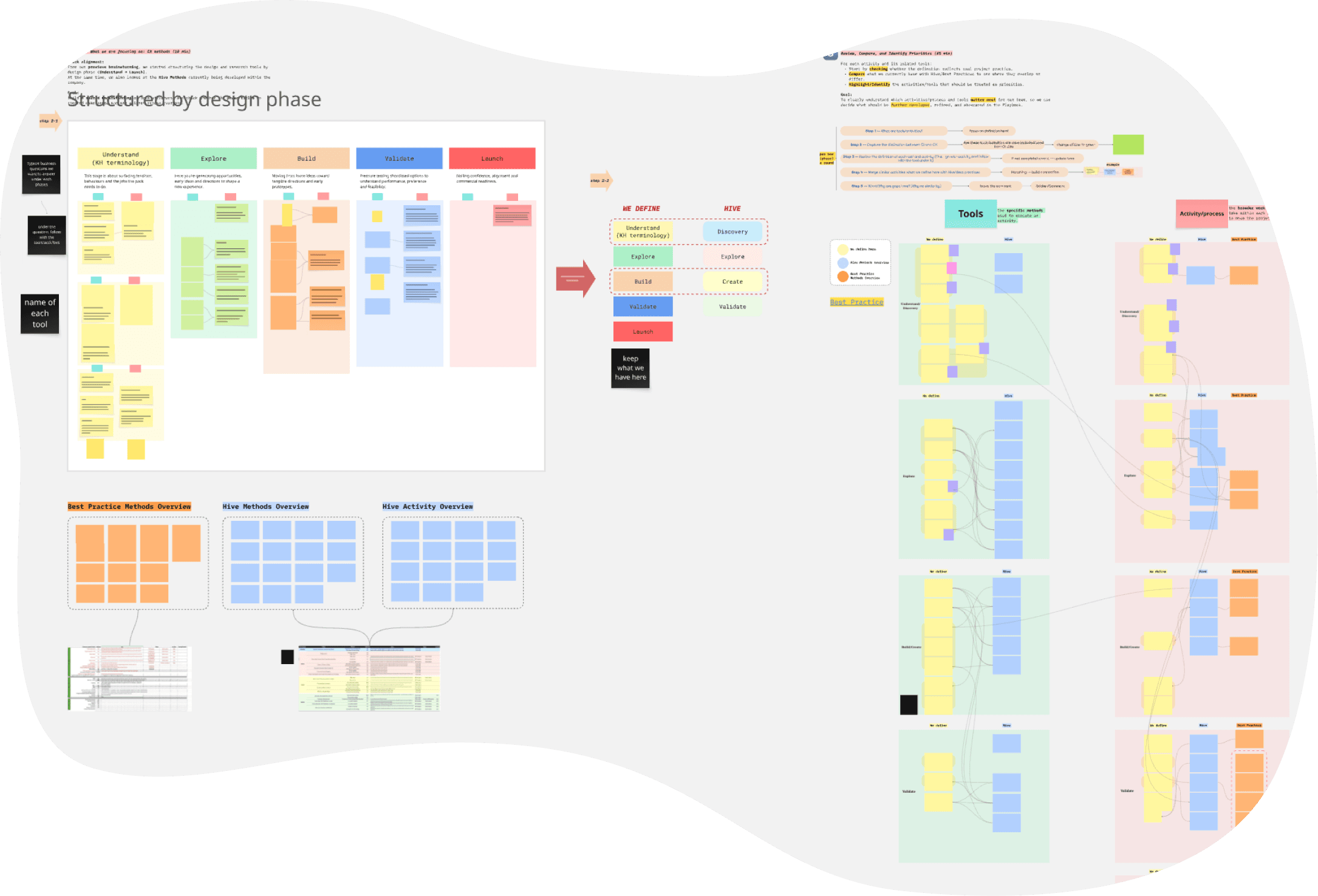
A co-creation workshop was conducted to validate and align the structure, revealing gaps, overlaps, and the need for having typical business questions under each phase.
the Pack CX Playbook
A structured system that connects consumer experience insights with packaging design processes, enabling teams to navigate and apply CX in real projects.
Explore our interactive Playbook!
Design Improvements
Where to start the CX process
Improved the entry experience with clearer visual guidance and starting points.
Inspacktor as a concrete example
Applied the Playbook structure to an existing document, refining both content and visual presentation to demonstrate real-world use.
Phase structure redesign
Reorganized each phase page by integrating tools, methods, and activities into a unified structure, supported by placeholders such as checklists and magic links.

From structure to a usable system.
Next steps
Refine the visual design and interaction to improve clarity, usability, and alignment with the company’s design language
Further develop tools, methods and activities within each phase through continuous alignment with stakeholders
Explore additional content to ensure the Playbook meets real scenario needs
Enhance adoption by making the Playbook more engaging, practical, and easy to integrate into workflows
Reflection
Through this project, I shifted from just organizing content to designing a structured system.
Instead of focusing on what to include in the Playbook, I learned to think about how information is structured, navigated, and applied in real workflows. This required balancing clarity, usability, and alignment with stakeholders.
Working closely with cross-functional teams also helped me understand the importance of continuous alignment and communication. Rather than designing in isolation, I learned to validate ideas through discussions and co-creation, ensuring the system reflects real needs.
Beyond strengthening my design skills, this project reshaped my understanding of UI/UX design. I learned that effective design goes beyond surface-level visuals, requiring deeper consideration of system structure and how solutions truly meet user needs.
Most importantly, this project pushed me to design for real-world use. I started to consider not only how the Playbook looks, but how it can be engaging, actionable, and adopted in practice.
I would like to thank my mentor and team members for their support and valuable feedback throughout this project!
Thanks for being here! Here’s a little more about me :)
SIDE WORK